
No Creds Notes #1
World Models and New Grads


Hey!
Welcome to No-Creds Notes! I gained a lot of new subscribers since last week so I’ll quickly explain what this is. As opposed to my longer form essays that are more deeply researched, these will typically be quick(ish) takes about whatever I happened to find interesting during the week.
Sometimes they’ll only cover 1-2 topics, other times they might cover 5+. They can be as long as this one or only a quarter the length. It’s basically just my spot to riff about whatever I feel like to a hopefully semi-captive audience. Hope you enjoy!
If you’re new here, subscribe to receive Tuesday deep dives and a weekly No-Creds Notes roundup.
Building New Worlds
Yesterday, World Labs and Fei-Fei Li publicly launched Marble, their cutting edge “World Model”. Watch the video above for a quick example of what you can build with Marble or click here to play around with it yourself (for free).
This is a super exciting step in AI progress. There’s the obvious use case of building games and even the future of video using platforms like this, but what I think is most interesting and exciting is how it could impact the world of robotics and engineering.
Present day models aren’t built for robots. They struggle with size and distance. They can’t “rotate” objects or understand perspective. This was evident in the robot demo from last week’s No-Creds Notes. When X1’s robot, Neo, was loading the dishwasher, the glasses were clearly staged in the right position and just had to be moved from point A to point B.
World models promise to allow robots to perceive the world with a consistent understanding of perception, geometry, and physics, while being able to accurately predict how changes to inputs, including its own actions, will reshape its environment.
In manufacturing, world models allow for rapid design iteration. You could submit a picture of a previous iteration and simply explain how you want to change the design. If that first attempt doesn’t come out how you like, you could scratch out the problems and sketch a couple improvements along with verbal feedback and quickly develop a new prototype that’s already grounded in physics.
We’re not there yet though.
First of all, even if the models were developed enough, we don’t have the compute to run them publicly at scale. I shared on Tuesday about the huge data center buildout underway which will hopefully address this roadblock, but we’ve got a long way to go.
Compute aside, Fei-Fei highlighted 3 key areas of research they’re focused on to create a world model that is up to the task:
Universal Task Functions (UTF): The UTF that drives LLMs is “next token prediction”. This + scaling laws were the big unlock that drove the AI chatbot revolution. The complicated nature of physics and geometry have kept world models from finding a solution as simple and elegant as next token prediction, but the team is hopeful they can find one.
Large-scale training data: As you could probably imagine, the data required for world-building is much more complex than the textual data needed for LLMs. While data exists, much of it is flat, 2D images that lack the spatial depth needed.
Architectural innovation: They’re looking into a number of innovations, like tokenizing data into 3 or 4 dimensions instead of 1-2 and developing a “real-time generative frame-based model” (RTFM) that builds a concept of “spatial memory” to combine efficiency of real-time generation/rendering with consistency in the already-generated world.
We’ve probably got a number of years before this technology is able to be implemented at scale in business contexts, but that’s exactly what makes this moment fun.
We’re still in the blurrily-rendered alpha stage of teaching machines to see. The leap from perception to creation is coming and it’s going to redraw the boundary between the digital and physical world.
New Tool for New Grads
Much has been made about the pain in the new grad job market. A fifth of the class of 2024 and a third of the class of 2025 are unemployed. Even those who do find jobs are frequently underemployed or outside their field.
On Tuesday though, I saw something that gave me hope:
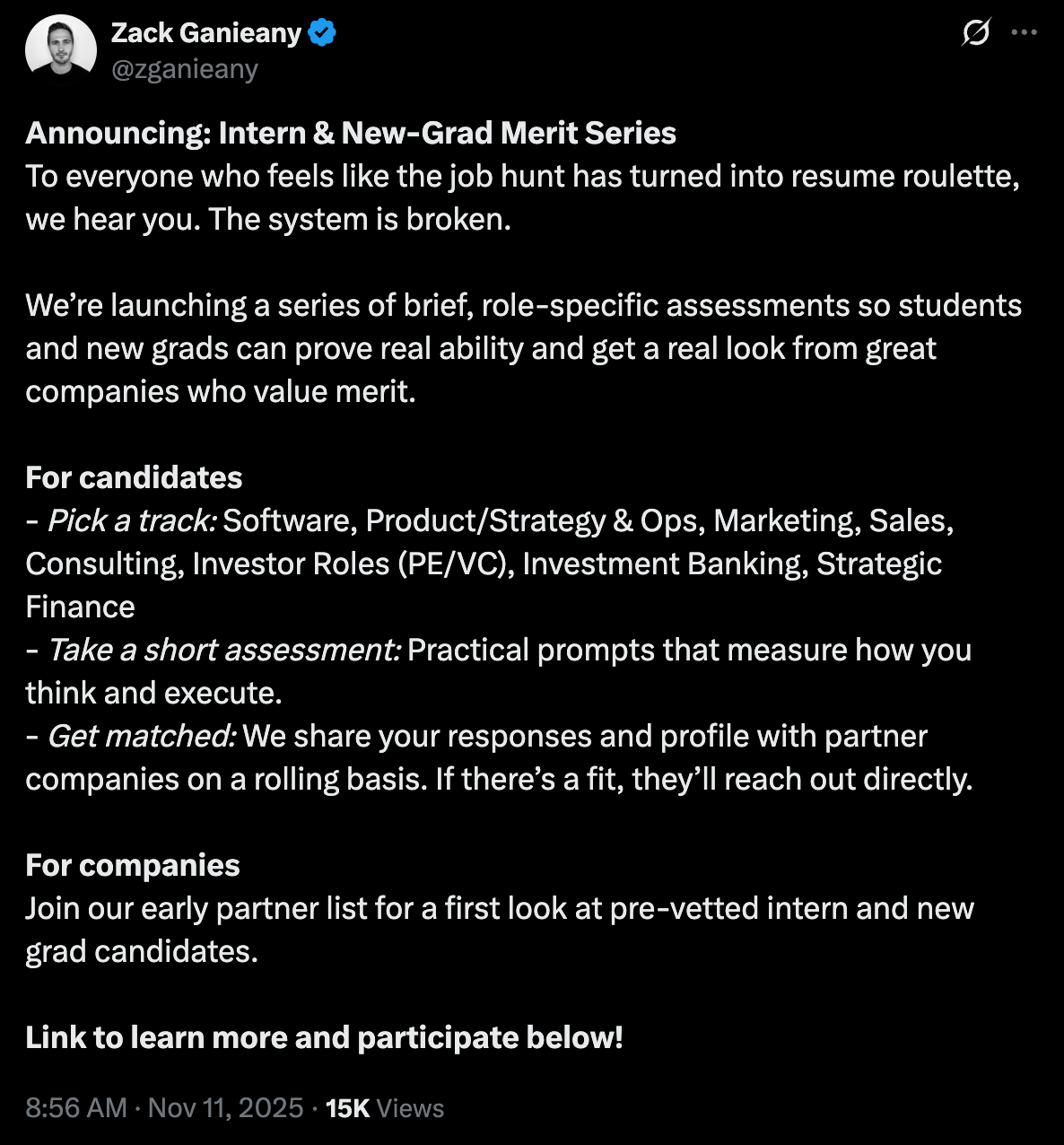
So what went wrong and why could MeritFirst fix it?
First I want to look at the problem from both the hiring side and the application side, before digging into how MeritFirst could solve it.
Hiring
There are plenty of fear-mongering articles about AI taking jobs but I tend to think that’s overblown. The bigger drivers in my opinion are macro-level monetary policy and company-level cost prioritization.
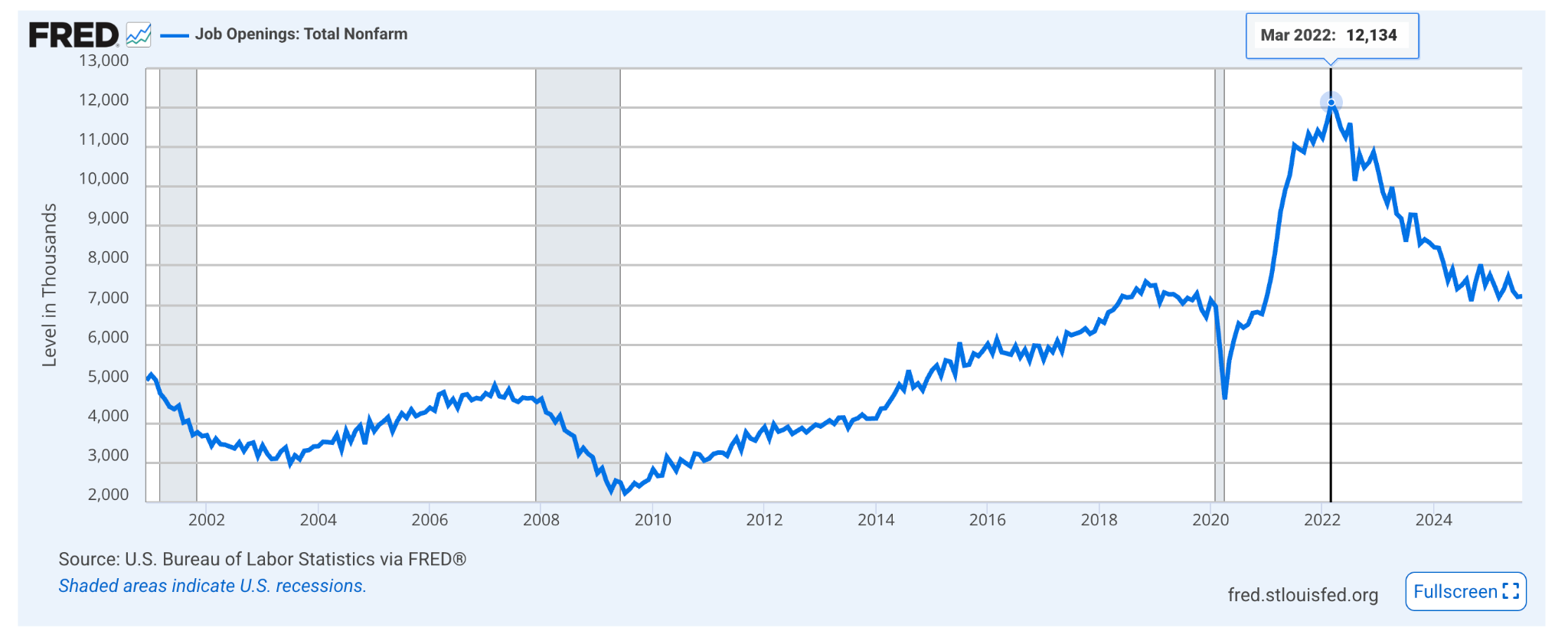
On the monetary policy side, the chart above shows that job openings peaked before ChatGPT came out and started the AI craze. Something did happen that month, though. In March 2022, the Fed began their post-Covid interest rate hikes. Then, the job listing graph flatlined when the Fed reversed course and cut rates in September 2024.
Making money more expensive slowed down hiring.
The second driver, cost prioritization, is tangentially related to AI. Many of the hyperscalers were considered top destinations for standout students to land at a couple years ago.
Since then, big tech has gone through a hiring freeze and only tepidly stepped back into early-in-career hiring.
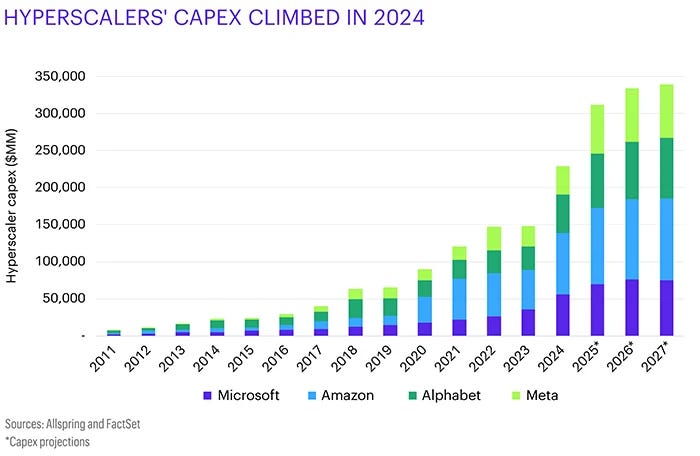
Over the same period, they’ve doubled their capex in AI infrastructure. It would be reasonable to assume that this increase in spend is at least somewhat connected to the hiring pullback, even if we can’t conclusively prove it’s causal.
A hiring pullback by “top-tier” employers trickles down all the way through the market. Suddenly, kids who previously would’ve ended up in big tech are sending applications to a number of companies they previously wouldn’t have considered, landing those jobs instead, and knocking dominoes further down the pile. Eventually you reach a mass of candidates who would’ve landed jobs under the previous environment, but not anymore.
While some people of course still land jobs they aimed for and others find unexpected fulfillment in the job they managed to land, this mechanism leads to broad swaths of the new grads feeling that they’ve underachieved relative to friends and/or siblings.
Applicants
At the same time that job listings have been declining, the number of applicants has been skyrocketing. Similar to the hiring market, I think there’s 2 trends at play here.
The first is tied directly to the decline in job listings. As sentiment turns negative, applicants feel the need to throw more at the wall in hopes something sticks. So all else being equal, applications sent per applicant would naturally increase.
But all else is not equal. Just like AI coding tools have dramatically increased lines of code volume, AI has enabled spammy job applicant behavior. Candidates are using AI to automate the tailoring of resumes to specific listings and iterating through 100’s to 1000’s of applications in their desired industry, overwhelming hiring departments with sheer volume.
Simultaneously, AI tools are adding noise to traditional resume signals. At least a couple years ago when I was still in school, most classes had not yet adapted well to AI. Students who were good at prompting could just as easily get passing (or better) grades without internalizing any of the content compared to students who put in the time.
While being adept at using AI is certainly a skill that many companies will be looking for, grit, teachability, and subject area interest are likely better long term markers of success. In the current state of the market, those are difficult to get a read on.
Enter: MeritFirst
While solving the supply side of job listings is probably beyond the scope of any single startup, MeritFirst is working to solve the applicant side. From their website:
American companies are in a crisis of broken talent filters. We reflexively screen for the same stale credentials: Ivy League degrees, FAANG experience, “prestigious” employers.
…
The problem is twofold. First, outdated proxies poorly predict real capability. A self-taught programmer who has shipped multiple products often has more relevant skills than someone with years of Java maintenance at a big tech company. An electrician turned entrepreneur who has built and scaled a successful local business typically has sharper business instincts than an MBA who has only analyzed case studies.
Second, and more damaging long term, we have no good systematic way to discover & assess exceptional people who don’t fit the “typical” mold. We know our country is filled with these people – we’ve backed many of them. But finding them is too dependent on chance encounters and personal networks – most haven’t had a fair shot to demonstrate their ability. For too long most corporations have spent their time checking outdated credentialization boxes and virtue signaling instead of building the Meritocratic Infrastructure to discover and empower America’s best talent.
They’ve come out with a platform to allow companies to assess candidate talent from the jump with 30-60 minute video assessments.
There’s 3 big reasons I like this:
Requiring an upfront investment of time (with video and screensharing!) should significantly reduce the application spamming that’s been plaguing the market, allowing candidates who play by the rules to get a fair shot.
Actually assessing knowledge and skills that are relevant to the industry is a much more fair and meritocratic way to hire than basing off of school, GPA, or other resume items. Give people the opportunity to prove they belong! (Also very mission-aligned with the whole “Uncredentialed” concept)
Centralizing applications gives power to the candidates. Allowing candidates to broadly apply for “New Grad Roles in Marketing” or “New Grad Roles in Consulting” or any of the many other industries included, gives a sense of scarcity to the hiring companies. They know that at any moment another company could swoop in and make you an offer, so if you put up a good interview, they’re incentivized to not only move fast in making a hiring decision, but make you a competitive offer too.
It’s still early days and there’s a lot of room for their partner network to grow, but I’m super optimistic about what platforms like this could do for the job market, especially for new grads. If the next wave of hiring runs on proof instead of pedigree, the best credential you can have will be showing what you can do.
(And if anyone reading this is a student or new grad looking for internship/job opportunities, check it out here!)
Other Noteworthy News and Reads
Twitter debated if the foundation model providers will beat out most other AI apps
Derek Thompson wrote on the male “lack of loneliness” crisis
If you liked this post, share with a friend who you think would like it too! And if you aren’t already, subscribe!