

👋Hey guys!
It’s Thursday morning, so you know what that means… time for another dose of No-Creds Notes! This week covers a technological breakthrough for in-road, wireless EV charging and exciting progress on bringing an end to autoimmune diseases. Let’s jump in!
But first… If this is your first time reading Uncredentialed, welcome! This is my twice-a-week newsletter where I share my “Uncredentialed” thoughts on current trends in tech, startups, and strategy. If that sounds interesting to you, join the family by subscribing below!

Bumper-to-Bumper Charging
They’ve lost some of their pandemic-era glimmer, but electric vehicles (EVs), along with a whole host of other electrified products, will win in the end. Because they don’t dissipate energy as heat on nearly the same scale as combustion engines, they’re simply too efficient to ignore, especially now that the upfront cost to produce them continues to drop.
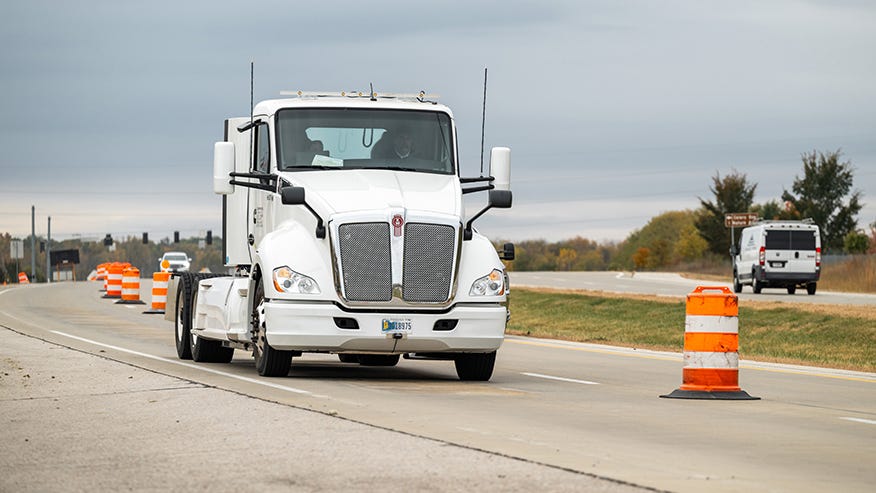
A couple weeks ago, researchers from Purdue University shared an exciting breakthrough that could go a long way towards furthering EV adoption. They successfully completed the first wireless charging of a heavy duty truck driving on the highway at 65+ mph.
Previous demonstrations of dynamic (in-motion) wireless charging have been on smaller/lighter vehicles and much slower speeds, both of which reduce the amount of power required. This time, the team was able to transfer 190 kilowatts (on the order of the power for ~100 homes) to the heavy duty truck as it traveled at 65mph along a quarter-mile strip of highway that had been outfitted to charge.
By building for semitrucks right off the bat, they’re optimizing for the commercial interests associated with moving cargo. The idea is that while consumers might generate some push for an exciting idea like this, the freight transportation industry could act as a spark for significant investment in retrofitting our roads to help them achieve the cost savings the tech could provide.
How does it deliver such impactful savings? Far and away the largest cost driver in an EV is its battery. By continuously charging the battery as you drive, the capacity required to keep the car operating between charges drops significantly. Instead of needing enough battery to make it 100 miles away to the next town over’s charger, you just need to drive along any charging-enabled road. Implementing this tech could dramatically reduce the size of batteries and, with it, the cost of an EV.
Along the same lines of abundant, on-the-go charging reducing the size of batteries is the reduction it would bring in stopping to charge.
Right now if a semi truck is driving cross-country with its load, a gas-powered truck can count on just driving along the highway and trusting a gas station will be there when they need it.
For an EV truck, that’s not necessarily the case. They’ll have to consciously think about how the weight of their load impacts their range and potentially take a meandering route to hit all the charging stops they need. Then, even once they reach the spot, they have to wait for the truck’s battery to get recharged.
Wireless highway charging fixes this, allowing them to drive straight through and, eventually, leading to even further cost savings by aiding the adoption of autonomous trucks.
Of course, these arguments don’t only apply to commercial interests. It also significantly reduces the cost of ownership for consumers owning EVs that can harness the tech, meaning across the spectrum we could see a significant rise in the number of EVs on the road in the coming years.
Questions still remain, in particular I’m curious what the cost/mile is to retrofit highways with the tech. The researchers claim their technique is more cost effective and scalable than any others so far, but I didn’t see any tangible numbers to better understand the breakeven of the investment.
Regardless of current costliness though, the proof of concept alone is enough to get excited. The whole electric stack is riding an exponentially improving cost-performance curve, and whether wireless EV charging becomes scalable in 2026 or 2036, it will get there. When it does, “bumper-to-bumper” will describe the seamless flow of electrons bumping along our highways, rather than the gridlock along the way.
Aut-NO-immue Diseases
Eric Topol shared an awesome post this week covering the exciting progress recently in curing autoimmune diseases.
Autoimmune diseases include all sorts of serious ailments like Type 1 Diabetes, Systemic Sclerosis, Rheumatoid Arthritis and more. Though they can begin with just mild symptoms, they often progress into becoming debilitating and, until recently, could only be treated, not cured.
The post shares 2 angles that scientists are pursuing to transition from a focus on mitigating symptoms to curing the disease altogether. To understand these approaches, it’s beneficial to consider your immune system along a continuum.
In the center is a healthy immune system. It fights off what it should fight off and it ignores what it should ignore.
To one side of this is a hypoactive immune system: it doesn’t respond when it should. This leaves a massive opening for cancer; as the body accumulates mutations, the immune system fails to clear them, allowing them to multiply out of control.
On the other side is a hyperactive immune system: it’s too busy fighting things that actually do belong in the body. This is the root cause of autoimmune disorders.The system is so dysregulated that it treats its own organs as hostile invaders, triggering a constant aggressive and inflammatory response.
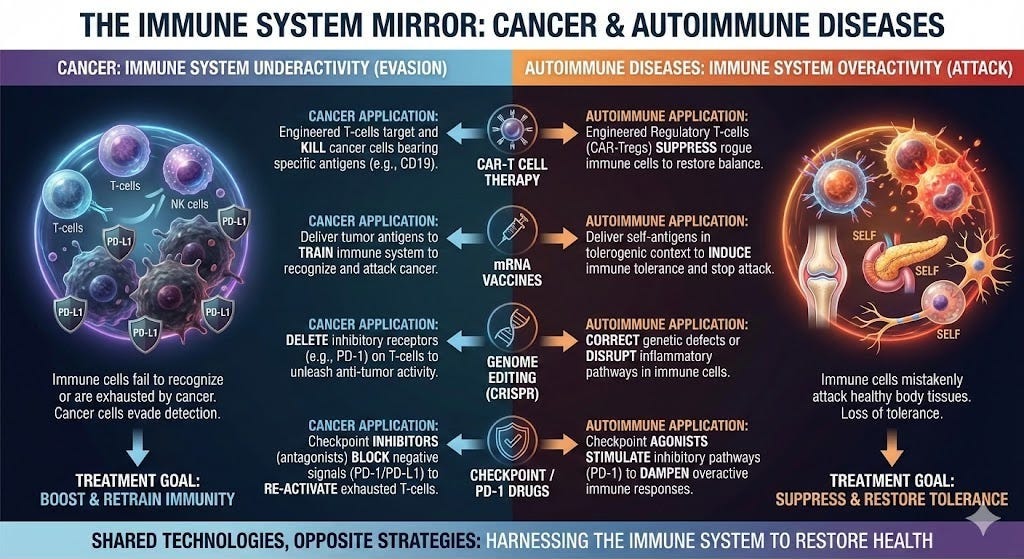
In this way, we can think of cancer and autoimmunity as mirror images of each other, not just in how they behave, but in how they’re treated. Using this framing, scientists have begun to think through ways they could treat autoimmunity in an equal but opposite way to how they treat cancer. Topol breaks this down into two buckets:
The Hard Reset: CAR T-cell Therapy
The Soft Reset: Inverse Vaccines
The Hard Reset: CAR T-cell Therapy
CAR T-cell therapy is the biological equivalent of a factory reset. Originally developed to hunt liquid cancers (a use case I spent a lot of time learning about during my Baylor Angel Network days while diligencing a CAR T startup focused on veterinary cancers), scientists are now engineering these T-cells to pursue the B-cells responsible for autoimmune attacks. By wiping out the rogue B-cell population, the body is forced to repopulate its immune system’s memory from scratch. Recent breakthroughs from Georg Schett’s team in Germany have already demonstrated this in patients with severe Lupus and systemic sclerosis, achieving the first documented case of one-shot functional cures.
This process is not without its faults, though. Under the traditional method, called ex vivo (or, out of body), you have to remove a patient’s cells, engineer them in a lab for weeks, and re-infuse them after a round of brutal chemotherapy. It’s painful, bespoke, and expensive.
However, an exciting new in vivo (in body) approach that uses mRNA and lipid nanoparticles to reprogram the cells directly inside the patient is showing promise. This would turn a complex, multi-week procedure into a scalable, off the shelf injection, moving the tech from a high cost luxury to a platform that can actually scale.
The Soft Reset: Inverse Vaccines
While CAR T is a blunt reboot, inverse vaccines act as a surgical operation. Standard vaccines train the immune system to recognize and attack a threat; inverse vaccines, as the name implies, do the opposite. They teach the body to recognize specific antigens as safe, stopping the false alarms that cause MS, Celiac, or Type 1 Diabetes. This is done by leveraging the liver, which acts as the body’s central registry for what’s allowed in the system.
By tagging a target antigen with a specific sugar molecule or hiding it inside a lipid nanoparticle, researchers can trick the liver into flagging that antigen with a “do not attack” command. Once the liver provides this clearance, the immune system backs off, stopping the chronic inflammation without suppressing the patient’s entire immune defense.
Bottom Line
The cost for these cures is still high, and the regulatory hurdles are significant. But the proof of concept is here. We’re watching the transition of biology from an unpredictable black box to a programmable interface. When we stop merely suppressing the immune system and start successfully programming it, we’ll move into an era where “lifelong condition” is a phrase of the past.
No-Creds Reading List
A NYT article shared a Groundwork study suggesting Instacart was engaging in price discrimination, kicking off an active discussion on Twitter. Brian Albrecht over at Economic Forces showed that there was not price discrimination, but instead A/B testing in a manner beneficial to consumers.
Arod Balissa shared a breakdown of the US Playbook to Win the Mineral Cold War
Guillermo Flor shared the definitive guide on How to Succeed as a Sequoia Investor. My 2 biggest takeaways were appreciating their perspective on mentoring “outlier” talent and that we should probably spend investing in crazier, riskier, more outlier businesses.
Steven McCulloch argued that once AI agents are able to independently generate more revenue than the energy costs to run them, AI evolution will become inevitable
The CEO of AWS said that companies trying to replace their junior devs with AI are dumb
If you enjoyed this post and want to receive more like it in your inbox, subscribe today! And if you’ve got friends interested in this type of stuff, send it their way!