
Productizing the Payload
How Starlink built SpaceX

👋Hey!
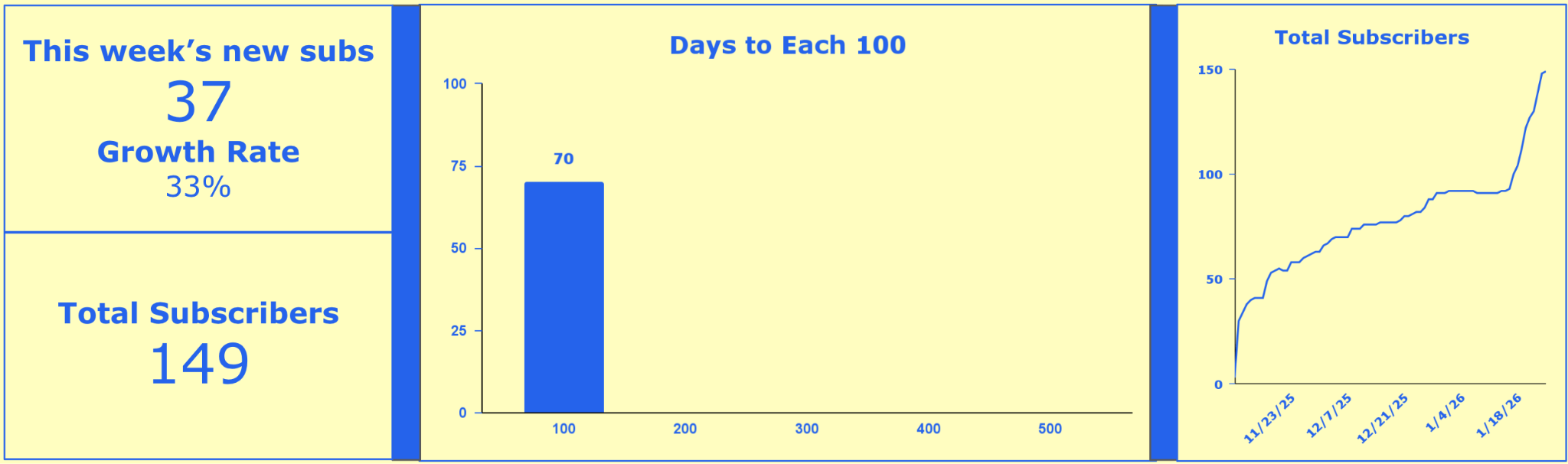
Wow, what an awesome week! Since last Monday, Uncredentialed hit 33% week over week growth and I can’t wait to keep the ball rolling! Last week’s post focused on how small modular nuclear reactors promise to “productize” the atom. If you haven’t read it, check it out here:

This week, I want to build on that idea of productization as a key driver of success for startups, especially deep tech/industrial startups, by looking to SpaceX as a case study.
Let’s get into it!
But first, welcome to 37 new Uncredentialed readers! If you haven’t already, you can subscribe too! It’s as easy as clicking the button below!
Productizing the Payload: How Starlink Made SpaceX
In 2025, SpaceX launched 165 rockets, more than every other country and company combined. China placed second with 68 launches while the US (ex-SpaceX) managed only 30.
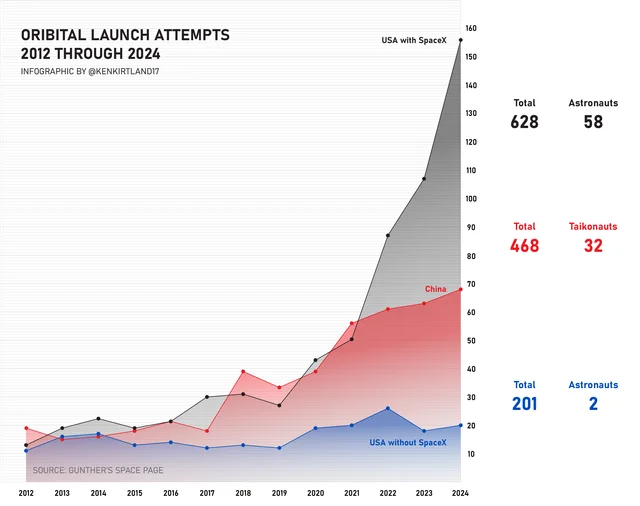
I think it’s relatively well known by this point, but SpaceX is the US space program. What I don’t think gets talked about quite as much, though, is that roughly 75% of those launches were their own satellites. They won the launch market not by outcompeting for customers, at least not at first, but by becoming their own best customer.
Reusability… Easier said than done
Everyone knew reusable rockets should be cheaper. Obviously, all else being equal, not needing to pay to build a new rocket is cheaper than paying to build a new rocket. In 1972, NASA launched the Space Shuttle program around this exact idea, but… it failed.
Over 30 years, the Shuttle flew 135 times, averaging less than 5 missions per year. After each flight, it went through months of inspections and refurbishment. Thousands of heat shield tiles required manual inspection and the main engines never attained their quoted range of 55 reuses. By the end, each launch cost over $1.5B, dooming the program.
Many are quick to point to engineering issues that caused problems, but from my perspective, the root of all these issues was simply volume. You can only benefit from learning curves when you’re producing at scale. The Space Shuttle never got the flight rate needed to drive down refurbishment costs or streamline operations.
SpaceX was similarly built on the back of the reusability thesis. Just like the Space Shuttle, the quoted economics sounded compelling. Musk shared his belief that, while reusability reduces payload by 40%, refurbishment costs represent less than 10% of building new, making it clear that it only takes a few launches to come out ahead.
Its goals laid out in front of it, SpaceX pursued reusability relentlessly. 7 years separate its first ever successful launch in 2008 and the first successful landing of their booster in 2015. 2 years later, in 2017, they’d reflown a booster for the first time. But in 2018, despite having technology that seemingly worked, they struggled to hit escape velocity. They launched 21 times which, while a company record, fell short of the volume needed to make the reusability economics shine and provided little learning curve boost to further improve costs.
Starlink Launches
When it was first announced back in 2015, opinions on Starlink were split. Fans pointed to the size of the global internet business, the number of underserved populations, and how extra revenue could fund investment in reaching Mars. Critics questioned whether launching satellites into space could ever be cost competitive with traditional internet.
I think both sides dance around the point of Starlink. Sure, some extra revenue never hurts, but, by this point, I think Elon had enough access to capital that it wasn’t a requirement. Similarly, while I wouldn’t doubt that critics may have initially been right about the cost competitiveness of satellites, SpaceX’s cost structure was always going to be a moving target.
In the satellite market, they’d found a space that:
Would require lots and lots of launches
Could be profitable in its own right
By building the Starlink business line, SpaceX became its own largest customer. Through this, Starlink could subsidize the hundreds or even thousands of launches required to learn and collapse cost curves, bringing the company’s mission of making humanity multiplanetary closer to reality.
Starlink Productizes Rockets
In May 2019, the first batch of 60 Starlink satellites went up. Then another batch, and another, and, by 2020, Starlink missions were over half of all launches. Just look at how dominant it’s become:
2019: 13 SpaceX launches, 1 Starlink mission (8% of manifest)
2020: 26 launches, 14 Starlink (54%)
2021: 31 launches, 17 Starlink (55%)
2022: 61 launches, 34 Starlink (56%)
2023: 96 launches, 63 Starlink (66%)
2024: 134 launches, 89 Starlink (66%)
2025: 165 launches, 123 Starlink (75%)
In just 7 years, SpaceX grew their launches over 12x, driven nearly entirely by their own internally-sponsored demand. Instead of waiting until a government contract comes up for bid and hoping they win it, their primary focus is on their own launch schedule with the occasional external contract interspersed.
With volume, the reusability vision has finally come true. One rocket booster in particular, B1080, has been used over 20 times, its most recent being its 24th launch earlier this month. On top of longevity, refurbishment time and costs between launches has also collapsed, with some re-launches coming in under 2 weeks!
With every incremental launch, the SpaceX team was able to learn and iterate on their rockets until reaching today where they have a virtual monopoly on US launches. At one point in time, other billionaire rocket businesses, like Bezos’ Blue Origin were right there in the discussion too, but today SpaceX is the runaway leader.
Productization as a Strategy
Launching products to customers to reach scale isn’t exactly an innovative idea. At minimum, YC has been preaching the importance of customer feedback since 2005. The difference is that the focus of the strategy has traditionally been software businesses.
I think the best strategy a deep tech or industrial business can make is to take a page out of the YC playbook and build a product that scales. Even if it’s adjacent to the actual end goal of the business, finding a way to generate the volume needed to ride learning curves can be the difference between a thesis that sounds good on paper and one that actually works.
Last week I wrote about small modular reactors and how their promise hinges on productization, shifting nuclear from bespoke construction projects to factory-built units. The SMR companies have a leg up on 2018 SpaceX, though. SpaceX needed enough capital to become its own largest customer while the surging demand for energy driven by the data center buildout gives SMRs all the customers they need.
Technology matters, but in any given category the path to reaching the best technology is through iteration over perfection. For deep tech and industrials in particular, it’s all too common to stay siloed away, letting perfect be the enemy of good enough, when the winner will be the one getting to market and learning.
There’s lots of companies building unconventional ideas that fit the Uncredentialed thesis, but the real differentiator will be those that are able to productize their idea and build a learning flywheel.
Like I mentioned in No Creds Notes last week, I’m super excited about the recent growth here and about “building in public” and fostering a whole community around Uncredentialed! Every share, recommendation, like, etc. goes towards building an awesome Uncredentialed community. To that end, here’s the stats for the week:
If you enjoyed this week of Uncredentialed, please share with a friend and help keep this thing going! And if this is your first time here, I’d love to have you join the community, all you gotta do is hit subscribe!