

Hey!
Happy Tuesday! It’s been a fun but busy week working to keep up this new 1 essay + 1 roundup per week cadence. Definitely harder than I expected, but also exciting to start sometimes really getting in the flow of writing.
This week’s post is the 2nd in my 3-part series on data centers. In case you missed it, part 1 was a dense read on what goes into building AI data centers. This week’s should be much lighter and ~25% as long, so if you were turned away by the density last week, fear not! Let’s dig in!
Welcome to my 38 new subscribers since last Tuesday’s email! If you’re reading this and haven’t subscribed yet, now’s the time! Subscribe to receive a weekly essay about tech, business strategy, and anything else I find interesting!
And if you’re one of the 38 and still like what you’re seeing, consider sharing with a friend to help make it back-to-back weeks of double digit growth!

Every part of AI runs on a different clock. NVIDIA powers the silicon clock, shipping a new GPU platform every 18-24 months. Model teams drive the model clock, trying to squeeze a breakthrough out of each new platform. And then there’s the physical clock, enabling all this progress but measured in years. It’s the clock of power lines, substations, transformers, cooling loops, and permitting offices.
Those clocks aren’t aligned. Satya Nadella has now said on two podcasts (BG2 and Dwarkesh) that piles of Microsoft’s GPUs are sitting in inventory because the data centers aren’t ready. Meanwhile, hyperscalers have already spent billions on Hopper and Blackwell, and NVIDIA is lining up Rubin for 2026.
That mismatch pushes the hyperscalers toward an ROI cliff. GPUs aging faster than the physical infrastructure needed to power them.
To see why that’s such a problem, you need to understand the economics of AI. Where do the returns actually come from? Why do frontier labs race to release a new model every 18-24 months? And why did the hyperscalers buy so many chips in the first place? Once you understand how a model pays itself off, the consequences of silicon time vs. infra time snap into focus.
The Economics of AI
Chips earn their keep 2 ways: they train new models and they run those models for users (inference). The economics look a lot like other fixed cost industries, like utilities and railroads, where you spend a massive amount upfront, and then slowly earn it back over time.
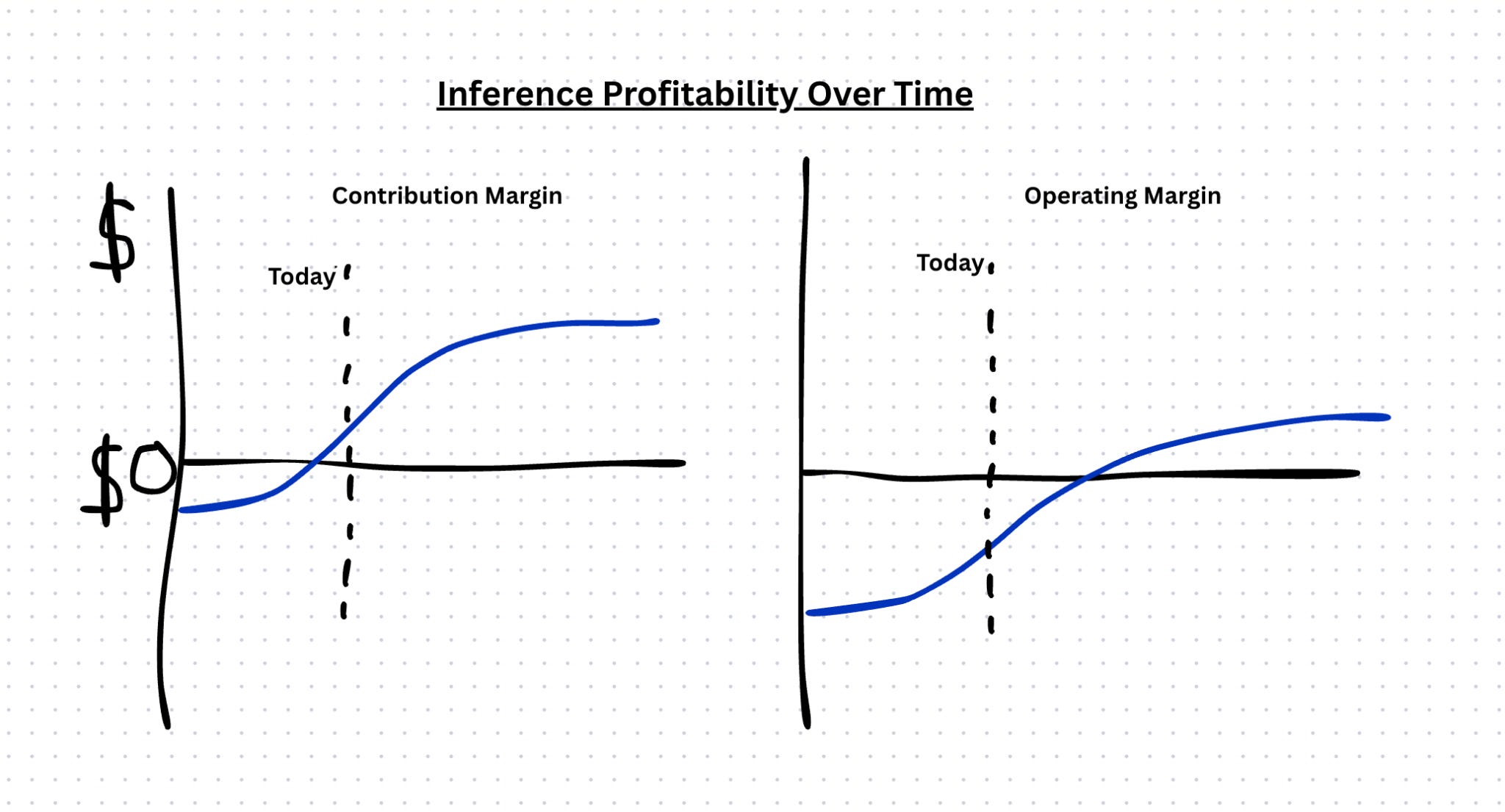
The profitability of inference is debated, but from what I can find, it’s likely that it’s already contribution margin positive on a per-token basis but looks less profitable when adding in costs like salaries, marketing, and other overhead. As data centers get more efficient and GPU performance improves, the cost per token drops and contribution margins rise. In theory, scaled inference demand should pay back the cost of training and infrastructure.
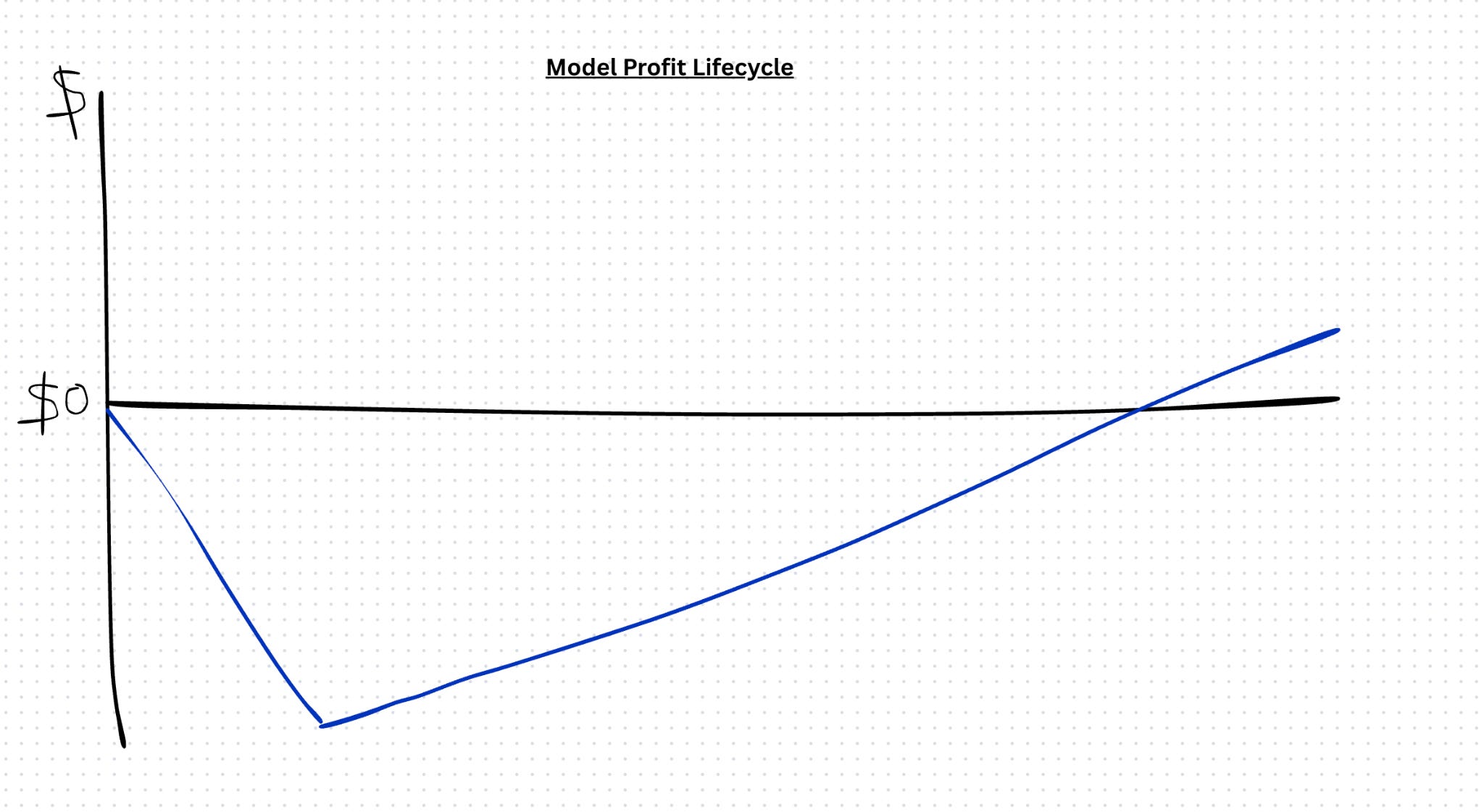
That gives each model the classic fixed cost payoff curve. A huge upfront hit during training is followed up by a long tail of repayment through inference.
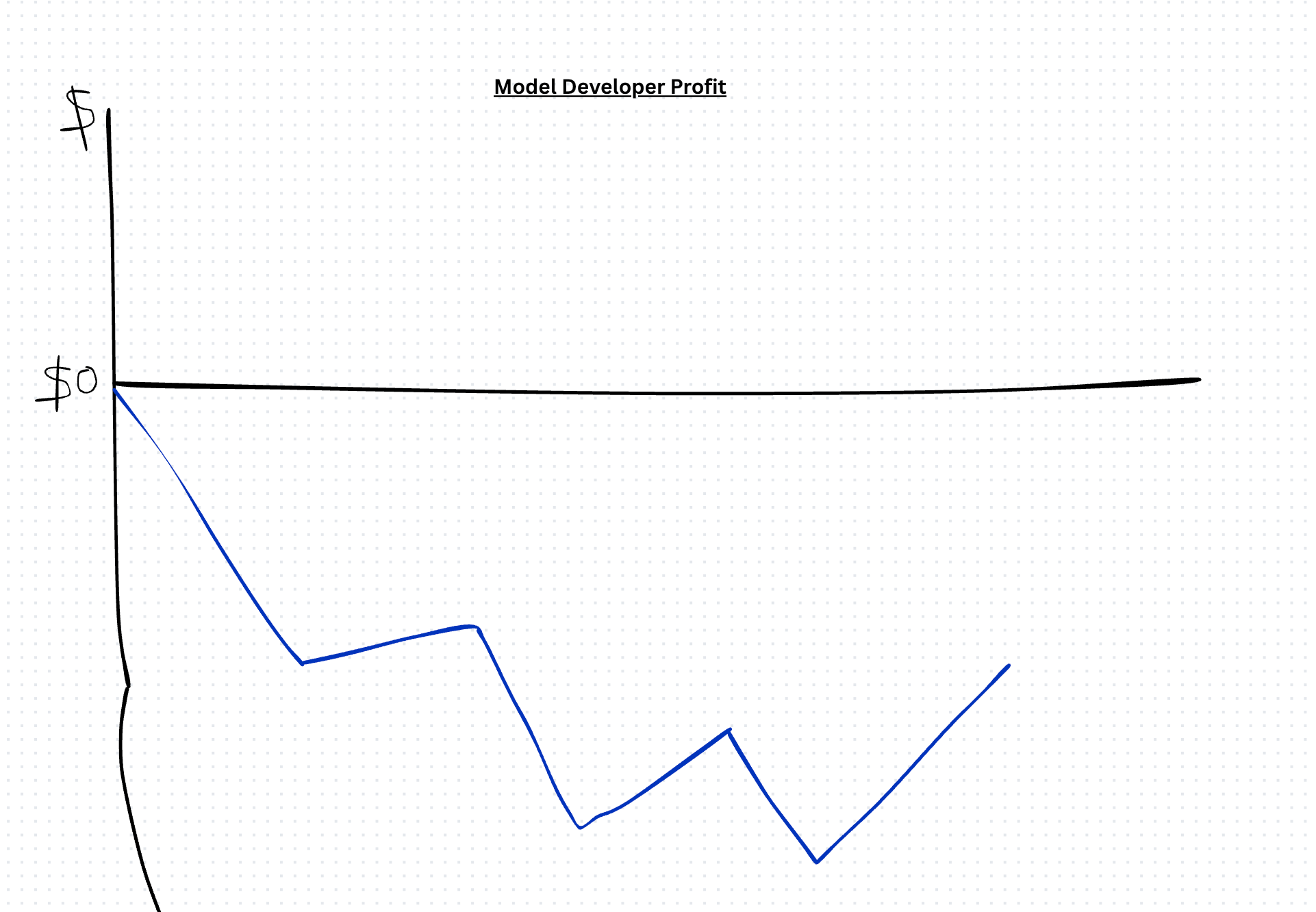
AI doesn’t exactly behave like a normal fixed cost business, though. Developers don’t stop after one model, instead they immediately start building the next frontier model. Why? Because API workloads (the deepest and fastest-growing source of token consumption) migrate almost instantly to whichever model is best right now.
That creates a pseudo-monopoly. For a short period after launch, the leading model captures the bulk of API traffic and downstream usage. Then competitors catch up with similar data, techniques, and GPU capabilities. Once capability converges, the market becomes competitive again and aspiring leaders must start training the next model to regain that API migration.
This convergence compresses the payback window. Every frontier model starts with a large negative cash outlay, earns back part of it during the short monopoly period, then gets leapfrogged, significantly slowing the model’s earnings. The entire economic structure hinges on the idea of inference demand and infrastructure efficiency progressing to a point where they can pay off the investment before becoming irrelevant.
So far, that hasn’t happened. The silicon clock keeps speeding up, while the infra clock slows everything down.
The Competing Clocks: Silicon vs. the Infrastructure
Last week’s “breezy” 5.5k word post broke down why the AI infrastructure buildout is moving on a decade-long clock. I won’t rehash the whole thing here, but the short version matters for this week’s argument:
Hyperscalers have already poured tens of billions into new data centers
They’ve hit bottlenecks at every layer: land, permitting, power, networking, etc.
The biggest constraint is energy supply
Each site takes 3-6 years, and the delays can stack even longer
Infrastructure moves on a years-to-decades clock.
Now compare that to the GPU clock.
NVIDIA ships a new architecture roughly every 18-24 months.
2020: Ampere
2022: Hopper
2024: Blackwell
2026: Rubin
And each jump is enormous. The transition from Hopper to Blackwell delivered 2.5-4x training improvements and 10-30x inference improvements1.
That’s why we’ve heard so much about the hyperscalers aggressively stockpiling GPUs. NVIDIA reported that they earned revenue of nearly $70B from data center GPUs in the first half of 2025 alone, with much of it going towards the leading edge Blackwell hardware. If your job is to train the next frontier model, you need a fleet of the world’s most advanced chips.
But the infra clock didn’t cooperate.
Microsoft has already said publicly that billions of dollars of GPUs are sitting in inventory because the data center shells, transformers, power feeds, and optical networks aren’t ready. The silicon clock is sprinting. The infra clock is crawling.
If those Blackwells aren’t online before Rubin arrives, a huge fraction of that generation will never lead the training of a frontier model. They’ll be left to just provide inference.
These chips were bought for training and for inference. Missing training means they never create the monopoly window for inference to generate returns. Hyperscalers may have bought a generation of GPUs that never get to pay themselves off.
The ROI Cliff
The compute crunch caused by insufficient infrastructure is already showing up in frontier models. OpenAI’s GPT-5 was trained on fewer FLOPS than GPT-4.5, something that makes no sense in a world of scaling laws.
Why would that happen? As the models improve, inference demand spikes. Without a matching increase in compute capacity that demand leaves only 2 choices: either accept higher latency or reallocate GPUs from training to inference. With stagnant supply, the reallocation is zero-sum. More inference means less training.
Now, OpenAI certainly didn’t wing it. They presumably sized the gains they’d have from modeling improvements to find a point of “MVC” (Minimum Viable Compute). But GPT-4.5 to GPT-5 is not the kind of step-change that frontier labs want. Labs want more chips and more data centers, not clever ways to make constrained compute “good enough.”
If limited training already capped GPT-5, then the next real jump can only come from more compute, not more cleverness. And, because the data centers aren’t ready, that compute isn’t coming from Blackwell.
Unless a meaningful share of new capacity comes online before late 2026, the next true leap in model performance will be trained on Rubin instead. Blackwell becomes a lost generation, too early in the data center build to train GPT-5, too late to train its successor. It’ll still deliver inference, but it won’t deliver the frontier training workloads hyperscalers modeled their ROI around.
This is the ROI cliff. Hyperscalers bought these chips assuming all of them would be online, earning and participating in frontier training. Delays mean only a fraction will. The gap between expected earnings and realized earnings is the cliff edge.
The fallout won’t be evenly distributed. Pure compute providers like CoreWeave should be fine for now. Shortages mean high utilization and rising prices. While they likely do have GPUs sitting in inventory as well, if anything, this could actually be their peak. Econ 101 tells us that if compute is all you sell, abundant compute probably hurts your business model.
Between constrained training capacity and limited inference, Model labs like OpenAI and Anthropic feel the squeeze but shouldn’t need to shoulder too much of the capex burden of building data centers. Their balance sheets aren’t carrying idle GPUs.
The hyperscalers are the most exposed. They sit at the infrastructure, compute, and model layers and were the ones spending tens of billions on Blackwell. But… they also are cash-rich and diversified. I’m not predicting “the end of Big Tech.” What I am doing is warning that if they don’t break through the infrastructure bottleneck fast enough, their financials will eventually show a generation of GPUs that never earned back their cost.
What happens once it starts becoming evident in the financials is the real question. Big tech has spent the past few years in an AI flywheel of more spending leading to more hype, leading to higher valuations, justifying more spending, and so on. This can only be sustained as long as investors continue to believe those all move together.
If markets begin to get antsy about AI spending, the flywheel could seize up. Progress wouldn’t stop altogether, but it would slow by years or even a decade. This is a show we’ve seen before. Web 1.0 overpromised and underdelivered, paid the price, and left the foundations for Web 2.0 to be built in the aftermath. AI could follow a similar path if the ROI cliff hits too hard.
The key difference between now and 2000 is that in contrast to the pre-revenue startups that powered the internet bubble, the AI bubble is built on the backs of the most profitable businesses on Earth. This means there’s also a real possibility that the hyperscalers simply push through and markets never notice. If they cross the infrastructure chasm quickly enough, the next generation of models and inference demand could fix the problem before it ever hits earnings.
So what happens on the other side of the ROI cliff? When the lost generation is written off, the infra clock finally catches the silicon clock, and intelligence becomes cheap enough to feel free? Come back next week for the 3rd and final piece of this series on data centers to hear more about it.
Thanks for reading! If you’re enjoying Uncredentialed, share it with a friend! (or 5!) And if you’re one of those aforementioned friends, 1) welcome! 2) subscribe here! and 3) if you enjoy Uncredentialed, you can be just like your cool+awesome friend and share it too!
The high end of these ranges are only reachable when used in hyperscaler-caliber configurations
The distinction between the "Silicon Clock" and the "Infra Clock" provides a necessary framework for understanding the current market friction. While the digital layer operates on a cycle of near-instant iteration, we are observing a significant recalibration where the physical layer—the "Infra Clock"—is reasserting its dominance over the global grid.
The data from early April 7th serves as a primary example: as energy logistics face immediate physical constraints, the valuation of tangible assets like gold and crude oil has established a new baseline that the digital economy must now accommodate. It appears that the era of "unlimited digital scaling" is entering a phase of energy-driven discipline.
A vital addition to this observation is the emerging role of decentralized financial protocols. They are no longer just "Silicon" entities; they are becoming the settlement layer for the "Infra Clock," attempting to bridge the gap between rapid capital movement and the slow reality of global supply chains. The true equilibrium will likely be found where the efficiency of the silicon chip meets the unyielding reality of the power grid. Excellent work on outlining this critical divergence.