
Go Deep
Why the AI era rewards specialists, not generalists

👋 Hey!
Happy Tuesday and welcome back to Uncredentialed! After checking out Universal Studios Hollywood with Bella and her mom over the weekend, I’m writing this while eating one of my favorite recipes (homemade Dan Dan noodles) so safe to say the week is off to a good start.
Today’s post pushes against the consensus narrative that AI will bring about a renaissance for generalist workers, arguing that specialists instead stand to benefit the most. Let’s get into it!
If this is your first time reading Uncredentialed, please consider subscribing to hear from me more often! And if you’ve been around the block a time or two, I’d love if you shared this with a friend.
Last year, a team from Harvard Business School and Boston Consulting Group ran one of the largest controlled studies on AI’s impact on professional work. 758 BCG consultants, randomly assigned to work with or without AI tools. The headline finding coming out of that study was that AI boosted the performance of the bottom half of workers by 43% while only improving top performers by 17%.
Wharton professor Ethan Mollick, who co-authored the study, had a word for the result: leveler. His argument, which has been echoed hundreds of times since in ensuing future of work discussions, is that specialized skills are being equalized. AI is now good enough at skills like coding, financial modeling, and legal research that the expertise gap between an expert and a capable amateur is shrinking. What matters now is adaptability and breadth or, put more simply, being a generalist.
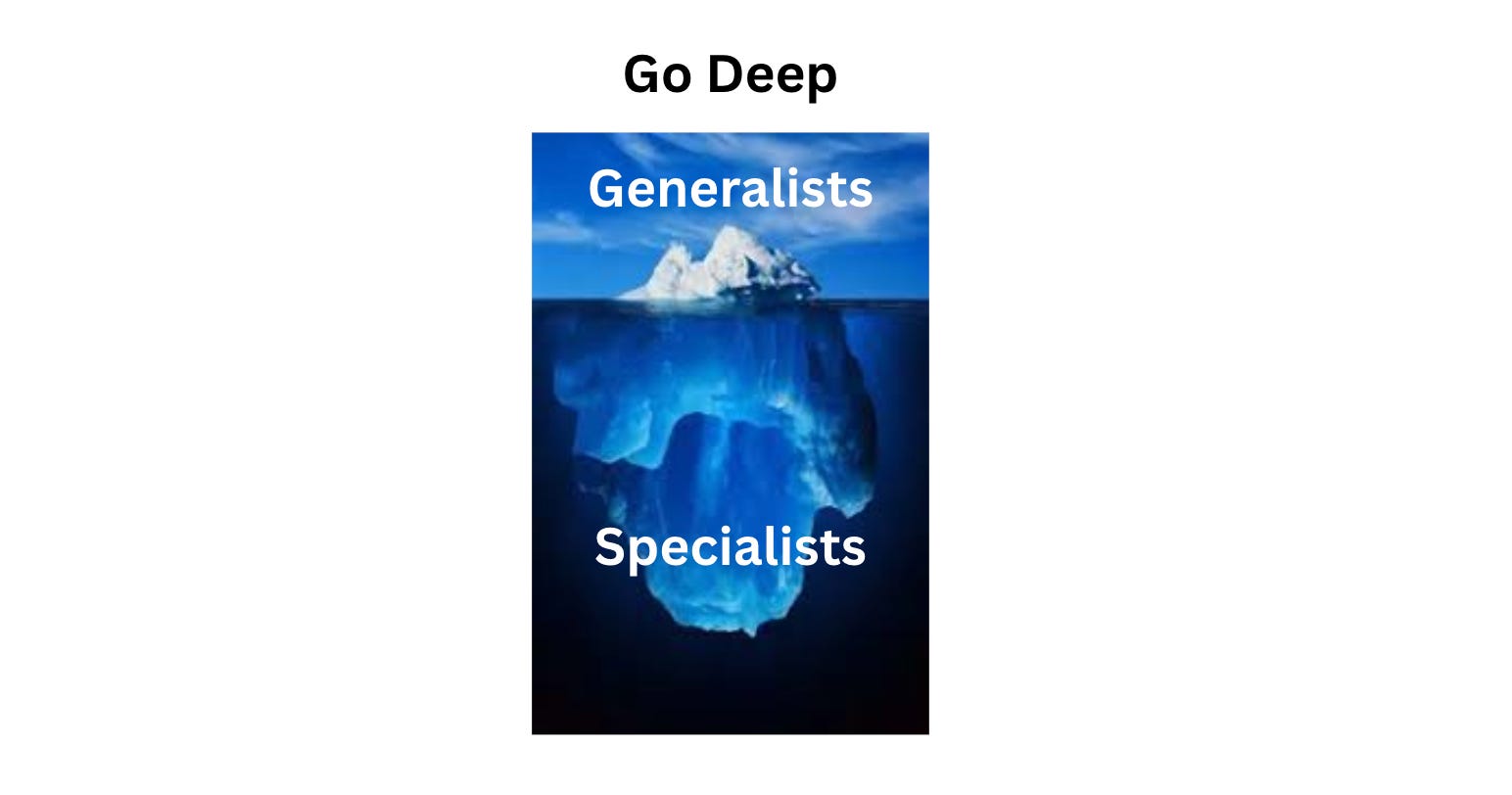
While the underlying data is right, I draw the opposite conclusion. It’s time to go deep.
What Happens When Everyone’s “Good Enough”
The generalist’s edge has always been breadth. Being a business guy with enough technical knowledge to cut out the PM middle man or the SWE who understood underlying customer and business needs meant increased productivity simply because the work was more efficient with less iteration. While AI might raise minimum required generalist abilities so that people can know what to prompt, I think the idea that generalists are the big winners in the AI era is fundamentally misguided.
AI simply raises the generalist floor uniformly for everyone. I, an econ major, can stream of consciousness spam my thoughts to Claude Code and have it automate frustrating workflows without diving into the code myself. An engineer can ask Claude to access pre-written business analysis skills and help edit and refine his work. AI makes everyone feel like a core capable generalist and so the story of AI enabling generalists to win is compelling because it makes everyone feel special, increasing engagement, and shaping the narrative.
At the end of the day though, AI will still be a leveler of skills. If everyone has access to the same archive of Claude Skills, there’s very little differentiation between output, especially from generalists who may lack the nuance of the specific thing they’re working on1.
We will all be made more productive through the use of AI because it will allow us to work on interdisciplinary work more independently and efficiently, but the dominant strategy will still be to find your differentiator. When the floor rises uniformly and we all begin to produce adequate work across disciplines, positive outcomes will concentrate on those at the ceiling with the most depth who push behind what the generalist AI tools can provide.
For Founders
On part 2 of their Google deep dive, Acquired’s Ben Gilbert and David Rosenthal made an observation about how Google allocated resources in the 2000s and 2010s. Every product that Google committed heavily to (Search, Maps, Gmail, Chrome, Android, etc.) was built on a key technological unlock that made something previously impossible possible on the web. XMLHttpRequest made Gmail’s real-time inbox possible. The ability to tile maps via AJAX made Google Maps possible. The market opportunities for email and mapping existed long before Google entered them but Google had a specific technical capability to do what others couldn’t.
It specifically came up that Google wouldn’t commit resources unless there was a specific underlying edge that most teams couldn’t replicate. There had to be a reason this team could solve the problem in a way others couldn’t.
In the AI era, that logic should be extended to every startup being built today. When AI equalizes execution by allowing any sufficiently motivated team to produce decent code, a functional product, and a passable pitch, the startup without an underlying breakthrough will be competed away by the next ten teams asking Claude to build them an MVP in the space.
This kind of gets back at one of Peter Thiel’s big points of emphasis in Zero to One. He argues that startups should look to monopolize a small market with a truly novel product and iterate from there, rather than launch an incrementally better product in a popular market.
That core monopolistic insight can be technological. It can come from a structural understanding of how a market actually works, accumulated by spending years inside it. It can be a business model insight that’s only visible to someone who’s seen the dynamics play out up close. What it can’t be is general.
For Creative Work
In February 2023, Clarkesworld Magazine, one of the most respected science fiction publications in the world, was forced to close submissions because it was drowning in AI-generated stories.
Before ChatGPT, Clarkesworld received fewer than 25 spam submissions per month. By February 20, 2023, they were receiving 50 AI-generated submissions before lunch on a single day. Editor Neil Clarke closed the queue that afternoon. He described the submissions as “among the worst we’ve ever received and sometimes bad in entirely new ways.”
The easy read on that story is that AI is bad for writers. But look at what actually happened to the market. The generic tier became flooded with undifferentiated content, generated quickly and at zero marginal cost, but the publication itself didn’t collapse. Clarkesworld kept publishing and ultimately won his third consecutive Hugo for Best Short-Form Editor in 2024.
What the AI deluge changed was the premium on genuine originality. When good enough content is abundant and free, work that comes from a writer who went deep enough into the craft to find territory no one else had mapped becomes more valuable by contrast. The creative specialists who had pushed past the edge of the known were not the ones getting replaced, if anything the contrast made them even more appealing. The same should hold true across other creative disciplines, too. A painter whose work deeply reflects their personal journey and pushes the edge of what people create will continue to hold value, while mid art that’s impersonal and undifferentiated loses its value.
For Knowledge Workers
A couple weeks ago I wrote about why businesses that fail to eliminate the rote, repetitive parts of their workflows are falling behind. While the argument there was about companies, there’s a more personal version of it for individuals.
The knowledge worker’s most durable edge in the AI era is about asking better questions, not just producing a high volume of output.
AI gives you leverage over anything you can specify, but that specification requires understanding. Definitionally, if the AI can come up with the topic without specific prompting, it’s a generic and undifferentiated insight. A user with a little bit better knowledge might be able to bring in a couple unique perspectives to consider, maybe the engineer brings up a couple frameworks they want to see implemented that the accountant wouldn’t even know to ask, for example, but this continues to slope with expertise.
The seasoned expert in the field will be able to drive the narrative through which the AI works better than any generalist could dream of. The path to successfully navigating the AI transformation for knowledge workers lies in having the judgment to automate routine tasks, while holding the drive to use the spare time that automation enables to go deep on the most important topics of their field.
Go Deep
No matter what field you aim to enter, it would be easy to skim the generalist-affirming headlines and feel relaxed and bullish about your job future. Maybe mixed with a little anxiety over AI-driven job displacement, but content to keep producing status quo outputs with less and less hard work to make it happen because you tell yourself you’re just an awesome generalist and that’s why you’re getting so much faster. This is the exact wrong stance to be taking and the way to turn those job loss anxieties into reality.
Status quo work, even tasks that used to be considered laborious, will be made table stakes by AI. In order to succeed, you have to go deep.
If you found this useful, share it with someone who’d appreciate it. And if you haven’t subscribed yet, join the Uncredentialed family below.
I’m saying Claude throughout this piece because it currently has the most momentum, but you can substitute whichever agentic model happens to be in vogue at the time you read this