
No Creds Notes #4
A New Manhattan Project and a Chatbot-Free Future


👋 Hey!
Welcome to another No-Creds Notes! Writing this one from the hotel lobby on my work trip and feeling ready to be back home. Today we’re talking about the Trump admin’s new mission to fuel AI progress and AI interaction models that go beyond chatbots. Let’s dive in!
New here? Uncredentialed is a twice-a-week newsletter focusing on tech, strategy, and the future, with essays on Tuesdays and roundups on Thursdays. Subscribe to join the 67-member Uncredentialed community.
A New Manhattan Project
Last week, the Trump administration announced the Genesis Mission, “a dedicated, coordinated national effort to unleash a new age of AI‑accelerated innovation and discovery that can solve the most challenging problems of this century.”
This is a direct reaction to the blockages I talked about in So You Wanna Build a Data Center and The Silicon Clock vs. The Grid Clock. Permitting and energy shortages are making it too difficult to build new data centers, the infrastructure that powers AI progress, and industry experts and politicians alike feel concerned the slowdown risks the nation losing its AI supremacy.
With the announcement of this mission, the government is recognizing that AI is more than just another cool tech innovation, but actually a key national security technology.
The announcement lists a number of new initiatives and goals that broadly aim to:
Understand our data
Understand our infrastructure
Understand the challenges blocking the development of AI
Particularly exciting to me, the announcement pushes the DOE to identify 20 challenges that are blocking the development of AI, from semiconductors to biotechnology to quantum computing and more, so that the administration can work on targeted solutions. It doesn’t do anything in and of itself but it lays the groundwork for future solutions.
I’m encouraged to see high level buy-in around the urgency of AI development, especially the focus on removing barriers, but I couldn’t keep myself from thinking about a quote in Packy McCormick’s Infinity Missions piece:
“When faced with potentially infinite outcomes - whether infinite upside or infinite downside - humans respond differently than we do to merely large numbers. Which is how you get the Manhattan Project, and why it’s proven impossible to create the Manhattan Project for X when the stakes are not infinite.
When infinity enters the equation, normal cost-benefit analysis breaks down. Any finite cost is worth paying for even a tiny chance at infinite upside or to avoid infinite downside.
When infinite stakes appear, impossible things become fundable.
I am using infinity loosely here, but you get the point.
Infinity Missions – whether avoiding infinite downside, pursuing infinite upside, or both – are responsible for some of humanity’s biggest achievements.”
I’m just not convinced that America writ large views AI as an “infinity mission.” I have no doubt that the frontier labs and hyperscalers do, but they have a long way to go to prove it to a broader audience.
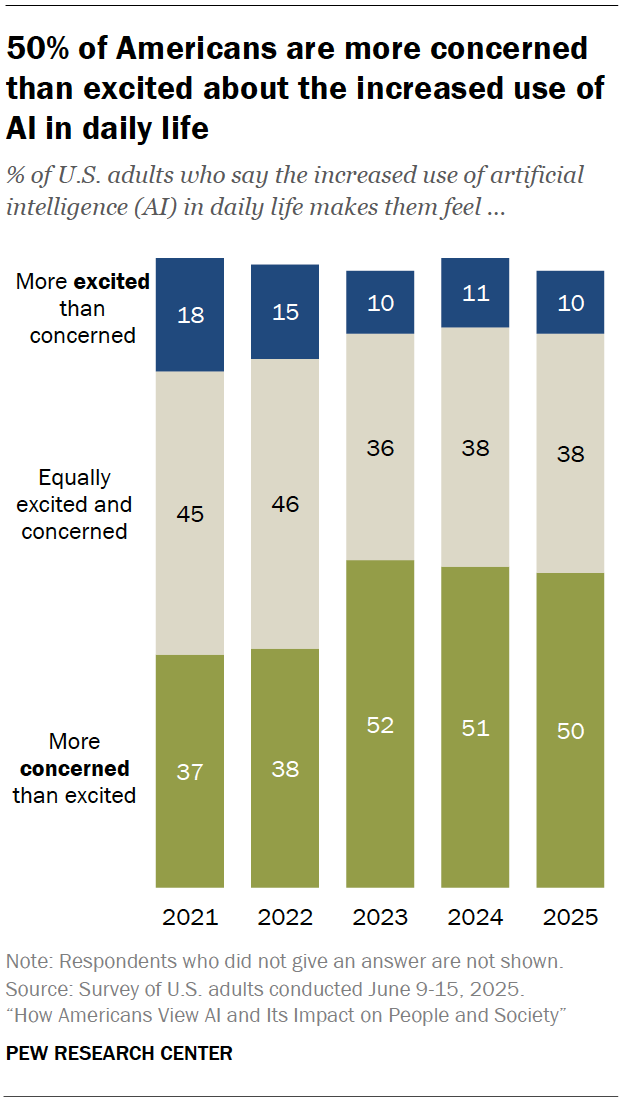
Specifically, the chart above tells us that much of the nation views AI progress as closer to an infinite downside scenario that will destroy jobs, rather than an infinite upside thing that will bring prosperity. Only 10% of people are more excited about AI than concerned. That stat serves as both a reminder of the small narrative bubble we AI-enthusiasts live in and of the uphill road that AI faces.
Further, while the announcement is exciting for what it signals about support from the upper reaches of our government, it’s mostly filled with directional support rather than specific, tangible details on how it will bring about an AI revolution on par with the Manhattan Project.
I hope that the Genesis Mission is able to turn the tide on AI. Optimistic, even. But I’m hesitant to call it a true success until I see strong responses to the DOE’s list of AI challenges.
Beyond Chatbots
In my post on Tuesday, I talked about the potential for AI to bring about a change in how we use computers. While it’s something I’ve thought about for awhile, I was prompted to include it by this recent exchange on X:
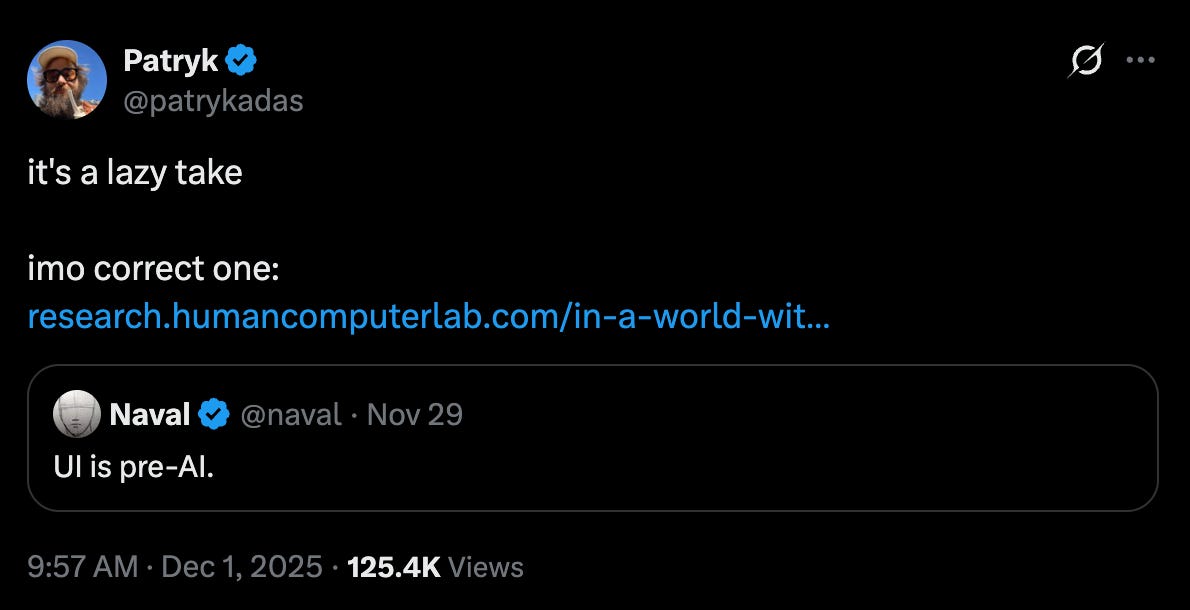
The linked article (also linked in my section title) asks the question “what if chat interfaces are actually holding us back?” It gives the example of asking ChatGPT to give you reminders, explaining that something like Apple’s Reminder app is a significantly better form factor than needing to read through a paragraph of text like ChatGPT provides.
Instead, AI likely could allow us to move to a future with no apps. Replacing apps, we would have a suite of agentic systems that intuitively can understand how you think and what you want, showing an on demand visualization of the data you need, built on a “just-in-time” basis.
Imagine a world where any/all data and platforms are created at a moments’ notice with exactly the info you need, without you needing to say or ask for anything. I can’t even begin to picture how that would be designed and am not confident that’s the end state (I feel like the intermediary product would be really frustrating until it gets good).
What I do feel confident on is that our platforms will be changing. Just like moving computers moving from labs to everyday life required a shift to the GUI, and smartphones led to the mobile-first interface, AI will bring its own interface uniquely suited for it.
No-Creds Reading List
Susan Montgomery wrote about stability as a key trait in early stage founders
Nick Maggiulli wrote about the continued importance of critical thinking in the face of AI
If you liked this post, share with a friend who you think would like it too! And if you aren’t already, subscribe!